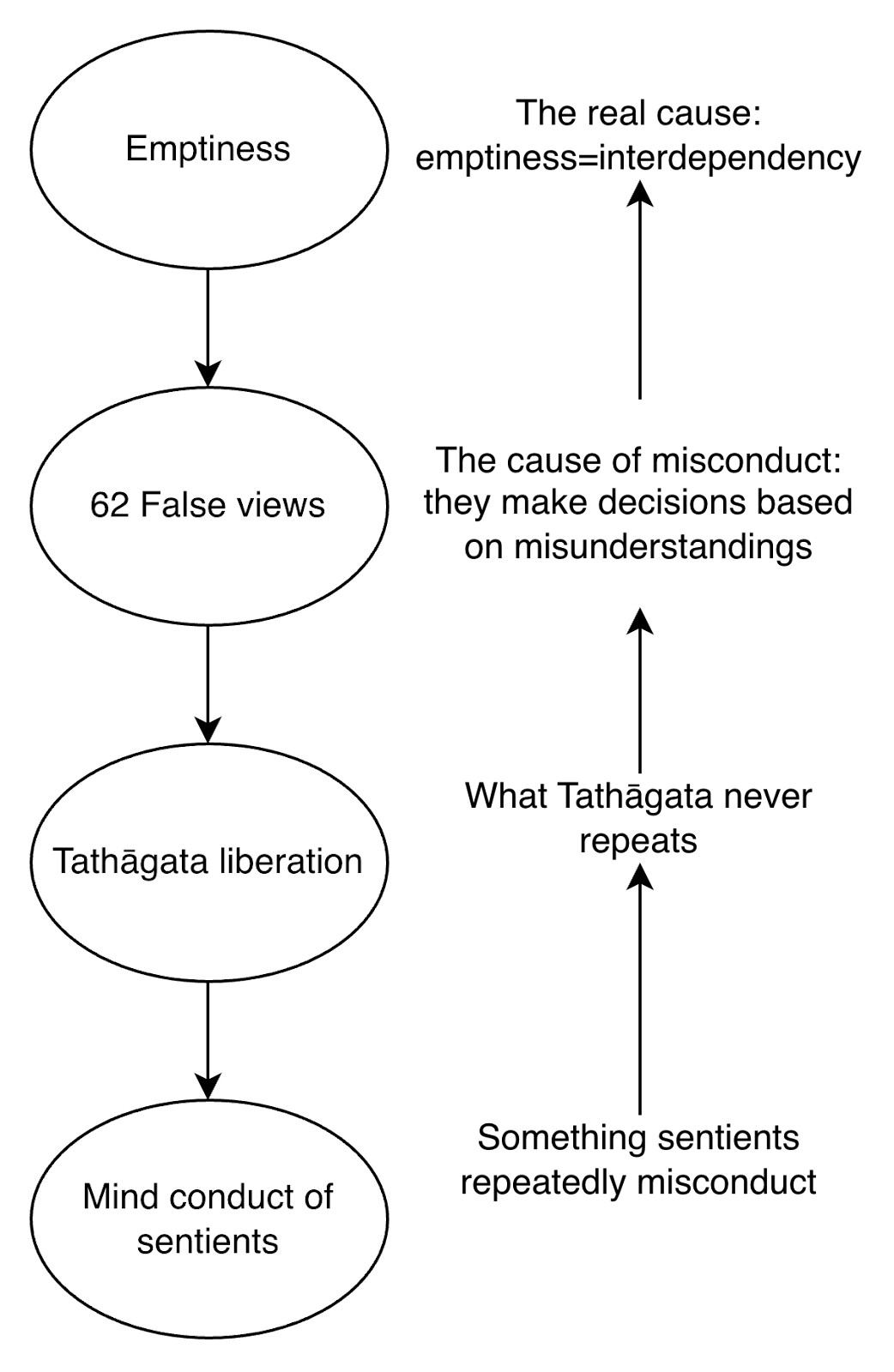
The Bodhisattvas’ skillfull walking ーA List from Vimalakīrtinirdesa Chapter 7. §1

Buddhism

 1. Vimalakīrtinirdeśa Chapter 7 §1

This is Chapter 7 §1 from Vimalakirtinirdesa : A Sanskrit Edition Based upon the Manuscript Newly Found at the Potala Palace. March 2006, TAISHO UNIVERSITY PRESS, TOKYO with removing |s.
Table 1.Vimalakirtinirdesa Chapter 7 §1 Full text.
atha : khalu mañjuśrīḥ kumārabhūto vimalakīrtiṃ licchaviṃ
evaʼm āha : kathaṃ kulaputra bodhi-sattvo gatiṃ-gato bhavati
buddhadharmeṣu
āha / yadā mañjusrir bodhi-sattvo ‘gati-gamanaṃ gacchati tadā bodhisattvoʼ gatiṃgato bhavati
buddhadharmeṣu
āha : katamac ca bodhisattvas yâgati-gamanam
āha : yadā pañcānantaryagatiṃ ca gacchati na ca vyāpādavihiṃ-sāpraduṣṭo bhavati
niraya-gatiṃ ca gacchati sarva-rajah-klesa-vigatas ca bhavati
tiryag-yoni-gatiṃ ca gacchati vigata-tamo’ndha-kãraś ca bhavati
asura-gatiṃ ca gacchati māna-mada-darpa-vigataś ca bhavati
yama-loka-gatiṃ ca gacchati sarva-puṇya-jñāna-saṃbhãropãttaś ca bhavati
aneñjyārūpa-gatiṃ ca gacchati na ca tad-gati-samavasaraṇo bhavati
rāga-gatiṃ ca gacchati vigata-rāgaś ca bhavati
sarva-kāma-bhogeṣu
dosa-gatiṃ ca gacchaty apratihatas ca bhavati sarva-sattveṣu
moha-gatiṃ ca gacchati prañā-nidhyapticittaś ca bhavati sarva-dharmeṣu
mātsarya-gatiṃ ca gacchati sarvādhyātma-bāhya-vastu-parityāgī ca bhavati
kāya-jīvitānapekṣaḥ duḥśila-gatiṃ ca gacchati sarva-sīla-śīkṣā-dhuta-guṇa-saṃlekha-pratiṣṭhitaś ca bhavaty
aṇumātreṣv avadyeṣu
bhayadarśī vyāpāda-khia-krodha-gatiṃ ca gacchati maitrī-vihārī ca bhavaty
atyantāvyāpanna-cittaḥ kausīdya-gatiṃ ca gacchati sarva-kuśala-mūla-paryeṣṭy-abhiyuktaś ca bhavaty
apratiprasrabdha-vīryārambhaḥ vibhrāntendriya-gatiṃ ca gacchati arikta-dhyānaś ca bhavati
prakṛti-samāpannaḥ dauḥprajña-gatiṃ ca gacchati sarva-lokika-lokôttara-śāstra-kuśalaś ca bhavati
prajñā-pāramita-gatiṃ-getaḥ kuhana-lapana-caryā-gatiṃ gacchati upāya-kauśala-caryā-niryātaś ca bhavati
saṃdhā-bhāṣya-kuśalaḥ māna-gatiṃ ca darśayati setu-saṃkrāma-bhṛtaś ca bhavati sarva-lokasya
kleśa-gatiṃ ca gacchati prakṛti-pariśuddhaś ca bhavaty
atyantāsaṃkliṣṭaḥ māra-gatiṃ ca gacchati apara-pratyayaś ca bhavati
sarva-buddha-dharmesu
śrāvaka-gatiṃ ca gacchati aśruta-dharma-śrāvayitā ca bhavati sattvānām
pratyeka-buddha-gatiṃ ca gacchati mahā-karuṇā-niryātaś ca bhavati
sattva-paripākāya
daridra-gatiṃ ca gacchati ratna-pāṇitā-pratilabdhaś ca bhavaty
akṣaya-bhogaḥ vikalendriya-gatiṃ ca gacchati lakṣaṇa-samalaṃkṛtaś ca bhavaty
abhirūpaḥ hina-kulôpapatti-gatiṃ ca gacchati tathagata-kula-gotra-sambhytas ca bhavati
puṇya-jñānôpacita-saṃbhāraḥ durbala-durvarṇāvahoṭimaka-gatiṃ ca gacchati nārāyaṇātmabhāva-pratilabdhaś ca bhavati
príya-darśanaḥ-sarva-sattvānām jīrṇa-vyādhito-glāna-caryāṃ ca darśayaty atyanta-vyāhi-samudghātitaś ca bhavati
maraṇa-bhaya-samatikrāntaḥ bhoga-gatiṃ ca darśayaty anitya-saṃjñā-pratyavekṣaṇā-bahulaś ca bhavati
sarvâiṣaṇâpratiprasrabdhaḥ antahpura-nataka-vyuhän ca bodhi-sattvo darśayati uttirṇa-kāma-paṅkaś ca bhavaty
aniketa-cārī dhandhāyatana-gatiṃ ca gacchati vicitra-pratibhānālaṃkāraś ca bhavati
dhāraṇi-pratiabahaḥ tīrthika-gatiṃ ca gacchati tīrtha-bhūtaś ca bhavati
Sarva-loka-gatiṃ ca gacchati sarva-gati-nivṛttaś ca bhavati
nirvana-gatiṃ ca gacchati saṃsāra-prabandhaṃ ca na jahāti
evaṃ mañjuśrīḥ bodhisattvo ʼgatigamanaṃ gacchati gatiṃgataś ca bhavati
sarva-buddha-dharmeṣu

2. The list of non-Buddha-lands and skills/character to aquire

I translated the list extracted from the section into English. I wish it helps readers in one way or another.
Table 2. The list of Bodhisattva challenge and skills
Skills Bodhisattvas’ve already obtained(C) Features of non-Buddha-lands Bodhisattvas go through(A) How Bodhisattvas become/are there(B)
1 Five Avicii Be not evil ones with malicious intention & longing to hurt
2 Hell Apart from every trouble
3 Animal Aprat form ignorance of lightlessness
4 Asura With zero arrogance
5 Dead mans Equipping every kind of fortune and virtue
6 Immovable mind Be not absorbed into it
7 Greed Apart from greed when enjoying every tresures
8 Rage Bringing up no trouble for every kind of people
9 Mohā Have insights to mind with wisdom in every Dharma
10 Stingy Aimsgiving all with inside and outside of themselves
11 Don’t grunge the life or body Breaking commandments Mastered every Sila, Dhutanga & established temperance firmly
12 Fear dishonor how small it is Ruin, vain, rage Stay in the mercyfulness
13 Never have malicious intense Sloth Focusing on exploring seeds of goodness
14 Focusing on practice perpetually Dispersion Fullfiledly mindfull
15 Expressing own nature Bad knowledge Expert in all worldly/transcendental scriptures/sciences
16 the completion of knowledge Hypocrisy and flattery Born to upāya
17 Skilled with words of deep wisdom Hubris Insured the ferry by the whole world
18 Distress Pure as own nature
19 Always untained Māra Never depending on the other teaching in every Dharma
20 Solely hearing teachings Let people hear the brand-new Dharma
21 Only-me-buddha Equipping great compassion to edificate people
22 Poverty Managed to seize the fortune
23 Endless enjoyer Have zero sensery organs Beutifully characterized with good features
24 Beautiful figure Underclass race Firmly sustained by thatagata family
25 Firmly sustains fortune and virtue Physically weak & visually ill Obtained Narayana body
26 Beloved by whole population Act of old & ill Finished the every cause of disease
27 Have overcome the fear of death Enjoy treasure Frequently gain insight of interdependency
28 Quest restlessly Decoration show & dance Dettached from craving
29 Homeless practioner Less talented Decorated with eloquence
30 Aquired Dharani Pagan True leader
31 The world Break free from the world
32 Nirvāna Continuous survival

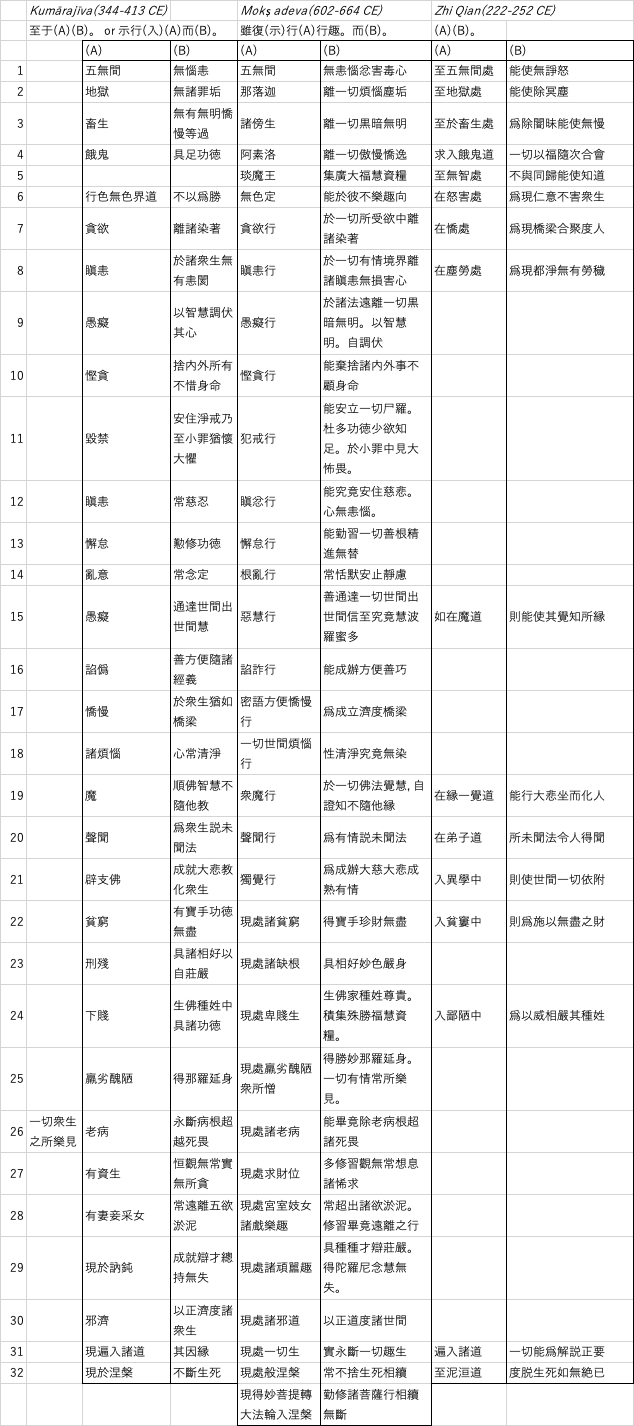
3. Difference between Chinese translation ver.

For readers’ reference, here I present a comparison of three Chinese translation from Japanese Taiśotripitakaṃ.
Note 1. Comparing my translation(Section 2. FIg 2. of this article), (C) parts are merged to previous (B) and the (C) meaning is not clarified. Recent translations from Sanskrit ver. like this also ignore (C) part. Kumārajiva 26th row “一切衆生之所樂見” is only (C) part found within traditional Chinese translations.
Note 2. Concerning 17th row, Kumārajīva and Mokṣadeva translated“setu-saṃkrāma-bhṛtaś” into the active voice, but “bhṛtaś” is actually passive voice. Additionally, according to Google Gemini, “setu-saṃkrāma”  particularly means the bridge of Rama from Rāmāyaṇa episode The battle of Lanka” . So this seems to mean “The skilled Bodhisattvas are insured the ferry by the whole world.” rather than “insure the bridge for the people.” Google Gemini conversation here. Old conversation on 2025/11/14 here.

Table 3. A comparison of three Chinese translations

コメント

タイトルとURLをコピーしました