Introduction
This is a short introduction of the importance of Magnesium in human bodies.Only 3 sections to read. If you need further informations, please feel ease to contact us from here. Since Magnesium is water soluble and the human kidney has the high tendency to wash out Magnesium from human body via urine(i.m.o., the sympathetic nerve stimulant causing Magnesium loss from urine is a major cause of Magnesium depletion pandemic in our modern society, the blog entry here), it is recommended that human beings with wholesome kidneies frequently supplement Magnesium in some form, which has been my recommendation since no later than 2021/12/10. It is the story-tellling explanation why human kidney is so Magnesium-resilient is they are still relying on “fish kidney” which allows them to filtrate sea water at all time.
Biological Function of Ca2+ and Mg2+
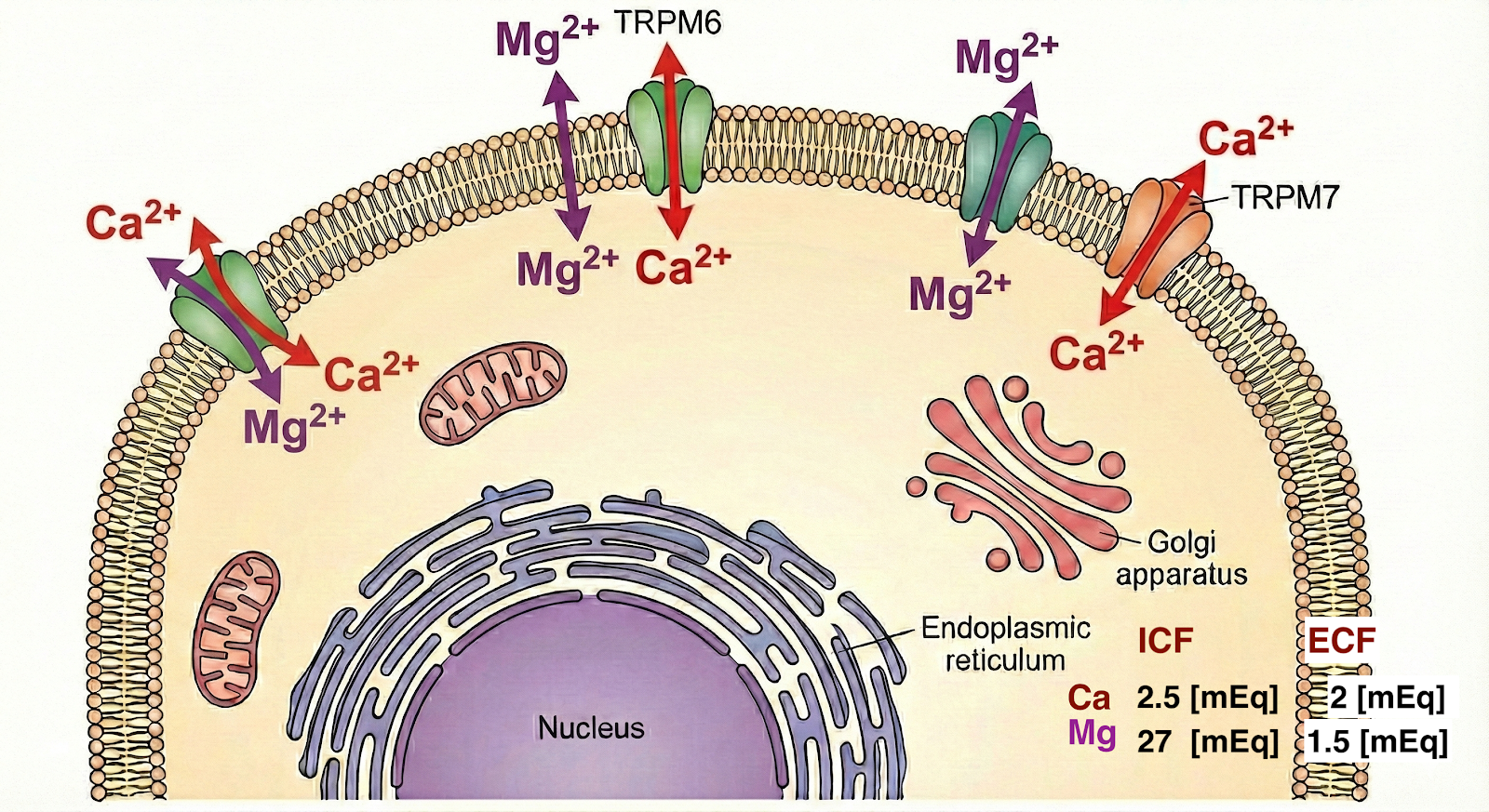
Ca2+ influx is the functional trigger of muscle and nerve cells(According to, e.g. Medical Biochemistry By Baynes & Dominiczak – (4rd, Fourth Edition) Japanese translation edition(2018).). Magnesium, a major cation component of the intracellular fluid(ICF) for human body cells, contribute to expel the Ca2+ from the cells after the functional event. Cations’ in-out flow go through exchangers or channels, e.g. NCX or TRPM family(Calcium clearance mechanism explained here ―unfortunately, this paper neglects TRPM family and other possibly exist channels(my commentary here). Kind reminder: Intracellular Mg2+ contributes to the voltage (the difference between intra- and extra-cellular electrochemical potentials) conformation because it is a major component of ICF. Note: On Nerve cells, it is known that Mg2+ has the unique role not only on voltage conformation. Details here). If not sufficient Mg2+ inside the cell, there may be some trouble bringing Ca2+ back to the original state, which causes e.g. the muscle stiffness or the nerve overexcitation(frequency and duration). See this(Google Gemini explanation, on history this) for the further understanding of Calsium-concentration-dependent muscle contraction.
|
Ca2+ influx to cell (流入)
|
Ca2+ expulsion from cell (排出) | |
| Muscle (筋肉) | to contract (収縮) | to relax (弛緩) |
| Nerve (神経) | to excite (興奮) | to calm down (鎮静) |

Magnesium dynamical flow in human body
The serum(in-blood) Mg2+ concentration is strictly controlled within the narrow width due to the kidney function. When it comes to the Mg2+ shortage in blood flow, it is recruited from the in-body storages like bones or ICF of body cells. Considering the mechanisms described above it means that the Mg2+ shortage in blood flow causes it squeezing out Magnesium from ICF or melting bone.


The function as co-enzyme for over 300 enzymes
Magnesium is known that it functions as co-enzyme for over 300 enzymes including ATP which is the “Energy currency”. Many cell functions including muscle contraction and Ca2+ expulsion(by PMCA, Google Gemini explanation here) depends on ATP consumption.
Few literature discuss on the Magnesium importance however there exists some e.g. this.
Appex. Intra- and Extra- cellular Components
Recall: Magnesium is a major cation component of ICF.
Electrolyte Composition of Body Fluids (mEq/L)
| Category | Ion | Plasma (ECF) | Interstitial Fluid (ECF) | Intracellular Fluid (ICF) |
| Cations (陽イオン) | Na+ | 142 | 144 | 15 |
| K+ | 4 | 4 | 150 | |
| Ca2+ | 5 | 2.5 | 2* | |
| Mg2+ | 3 | 1.5 | 27* | |
| Total | 154 | 152 | 194 | |
| Anions (陰イオン) | Cl– | 103 | 114 | 1 |
| HCO3– | 27 | 30 | 10 | |
| HPO42- | 2 | 2 | 100 | |
| SO42- | 1 | 1 | 20 | |
| Organic Acids | 5 | 5 | – | |
| Proteins | 16 | 0 | 63 | |
| Total | 154 | 152 | 194 |
Barriers between compartments (表の下の境界線)
- Between Plasma and Interstitial Fluid: Capillary Wall (毛細血管壁)
- Between Interstitial Fluid and Intracellular Fluid: Cell Membrane (細胞膜)
Footnotes & References (注釈・出典)
Note (*): In the Intracellular Fluid (ICF), the values represent total concentrations, including those bound to proteins. The concentrations of free ions for Ca2+ and Mg2+ are mEq/L and 1 mEq/L, respectively.
Sources
> 1. Shozo Koshikawa, Fluid Therapy, Chugai-Igakusha, 1985, p.17.
2. Yoshihiro Kubo (Ed.), Standard Physiology 8th Ed., Igaku-Shoin, 2014, p.53. English translation by Google Gemini here.
2. Yoshihiro Kubo (Ed.), Standard Physiology 8th Ed., Igaku-Shoin, 2014, p.53. English translation by Google Gemini here.

コメント